Learn About Kinstretch®
Functional Range Conditioning®, often called FRC®, is a joint training system used to help build mobility, control, strength and usable range of motion.
At Restore, FRC® sits inside our wider movement pathway. It helps inform how we assess, coach and support people who need better joint control, more movement options and a clearer way to build capacity.
Functional Range Conditioning® in simple terms
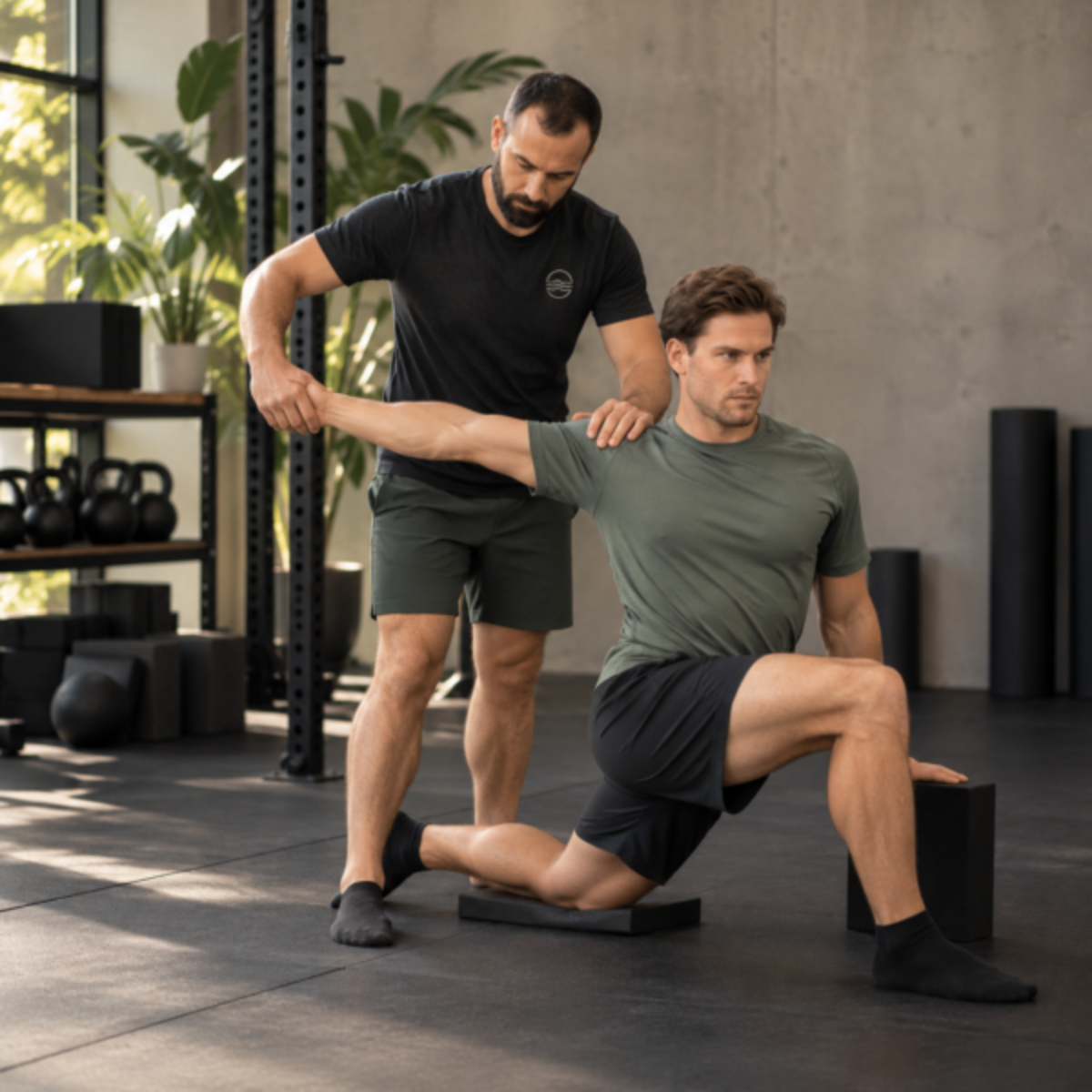
Functional Range Conditioning® is not passive stretching.
It is a system for training joints.
FRC® is used to help improve how much movement a joint can access, how well you can control that movement, and how much capacity your tissues have within those ranges.
At Restore, we use FRC® thinking to help people understand their body, build more usable mobility, and improve joint-specific strength and control.
The aim is not just to create more range. The aim is to create range your body can own.
Why Restore uses FRC®
Restore is built around the idea that external results start with internal control.
Your body needs movement options it can access, control and tolerate before it can reliably express strength, speed, performance or comfort.
FRC® helps us train those internal prerequisites.
We use FRC® principles because they support the Restore approach:
- Assess what a joint can currently access
- Improve awareness and control
- Build strength through range
- Train end-range capacity
- Reduce reliance on passive flexibility
- Create more usable movement options
- Connect joint training into the wider body and the wider pathway
This is why FRC® is part of Restore’s joint-specific movement work.
It gives us a framework for building capacity, not just chasing temporary movement change.
FRC® vs Kinstretch® — what is the difference?
FRC® and Kinstretch® are closely connected, but they are not the same thing. Functional Range Conditioning® is the broader system and framework for joint training, assessment, mobility development and tissue capacity. Kinstretch® is the group class expression of that system. A simple way to understand it:
-
FRC®
The broader joint training system and specialist framework.
-
Kinstretch®
The class-based method that applies many of those principles in a guided training environment.
What does FRC® help build?
FRC® helps develop the qualities your joints need for better movement.
Joint control
You learn to move and control specific joints with more awareness and less compensation.
Active mobility
You work on range of motion your body can access and control actively, not just passively.
End-range strength
You train strength and control in positions that often feel weak, unfamiliar or restricted.
Tissue capacity
You work to build the ability of joint tissues to tolerate load across broader ranges.
Body awareness
You develop a clearer understanding of what your body can currently access, where it compensates, and what may need more input.
Usable range
The goal is not just more motion. The goal is more movement you can own, control and apply.
How Restore uses FRC®
FRC® influences how Restore assesses, coaches and builds movement pathways. It may show up in different ways depending on what you need.
-
Movement Profile
FRC® thinking helps inform how we look at joint control, movement access, restrictions, compensations and priorities.
If you are unsure what your body needs, the Movement Profile is usually the clearest place to start.
-
Specialist Support
Selected FRC® 1:1 may be used when someone needs more targeted joint-specific input than a general online pathway, workshop or block can provide.
This is usually best suited to committed clients, complex movement presentations, individualised programming clients, spinal pathway clients or people chasing a specific movement outcome.
-
Individualised Programming
FRC® principles may influence the way we build individualised programmes, especially where joint-specific control, range development or tissue capacity is a priority.
-
Kinstretch® and Restore Online
Many people experience FRC® principles through Kinstretch®, Restore Online or In-Person Movement Blocks.
This is often the best way to build consistency without needing regular 1:1 sessions.
Who is FRC® 1:1 for?
Selected FRC® 1:1 is not the default starting point for everyone. It is most useful when someone needs a higher level of specificity. FRC® 1:1 may be appropriate if you are asking:
-
I need more specific joint training.
You have a particular joint, movement limitation or range that needs focused attention.
-
I have done general mobility work but need more precision.
You are no longer looking for a general class. You want a more targeted approach.
-
I have a complex movement history.
You may have previous injury, surgery, recurring restrictions or compensations that need more individualised input.
-
I am working through a spine or individual programming pathway.
You need specific joint training to support a broader plan.
-
I am chasing a specific performance or movement outcome.
You want more detail, more precision and more individual feedback than a group pathway can provide.
FRC® is not always the first step
Because FRC® 1:1 is specialist support, it should be used when it is the right fit. Many people are better served by starting with:
Restore Online
Best if you want consistency, joint strength and mobility training from home.
In-Person Movement Blocks
Best if you want coaching, feedback and accountability in a small-group environment.
Kinstretch®
Best if you want to experience FRC® principles in an online or group class setting.
Movement Profile
Best if you are unsure what your body needs and want Restore to recommend the right pathway.
Specialist Support
Best if you already know you need hands-on or highly individualised input.
The aim is to give you the right level of support, not the most complicated one.
Where does FRC® fit in the Restore Pathway?
FRC® is one of the key frameworks behind Restore’s joint-specific movement work. It can support several stages of the pathway.
-
Understand
FRC® helps us assess joint access, control and movement options.
-
Build
It gives us tools to build active mobility, end-range strength and joint capacity.
-
Get specific
It becomes especially useful when someone needs targeted joint-specific work.
-
Support
Selected FRC® 1:1 may sit within Specialist Support for people who need a more individualised approach.
-
Progress
FRC® can connect into Restore Online, In-Person Blocks, Individualised Programming, Specialist Support or reassessment depending on what your body needs next.
Frequently asked questions
What is Functional Range Conditioning®?
Functional Range Conditioning®, or FRC®, is a joint training system designed to build mobility, control, strength and usable range of motion.
Is FRC® the same as stretching?
No. FRC® is not passive stretching. It focuses on active control, joint strength, end-range capacity and usable movement.
What is the difference between FRC® and Kinstretch®?
FRC® is the broader joint training system. Kinstretch® is the class-based expression of that system. Many people experience FRC® principles through Kinstretch® classes, Restore Online or In-Person Movement Blocks.
Do I need FRC® 1:1?
Not necessarily. Many people do well with Restore Online, Kinstretch® or In-Person Movement Blocks. FRC® 1:1 is best when you need more specific joint training or individualised input.
Is FRC® suitable for beginners?
FRC® principles can be scaled, but 1:1 FRC® support is usually most useful when someone needs more targeted coaching. Beginners often start with Restore Online, Kinstretch® or a Movement Profile.
Can FRC® help with stiffness?
FRC® may help people who feel stiff by improving joint control, active mobility and usable range. If you are unsure what is driving your stiffness, a Movement Profile may be the best place to start.
Can FRC® help with injury history?
FRC® may be useful where previous injury, surgery or movement restriction has affected joint control or usable range. It does not replace medical care or diagnosis. If you are unsure, start with a Movement Profile.
Is FRC® used in Restore Online?
Restore Online may include classes and programmes influenced by FRC® principles, especially through Kinstretch® and joint-specific mobility training.
Can I book FRC® directly?
Selected FRC® 1:1 may be available by request or pathway recommendation. If you are unsure whether it is the right fit, book a Movement Profile first.
Where is FRC® available with Restore?
FRC® may be delivered through selected Specialist Support appointments, Individualised Programming, Movement Profile recommendations, Restore Online, Kinstretch® and In-Person Movement Blocks depending on what you need.
Want to know if FRC® is the right fit?
Functional Range Conditioning® is one of the systems Restore uses to build better joint control, mobility and movement capacity.
If you already know you need more specialist support, explore Specialist Support.
If you are unsure where to begin, start with a Movement Profile and we will help you choose the right pathway.